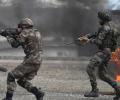
'Post the pandemic, when India is turning a new leaf in its economic policy with an eye on foreign capital and global supply chains that are likely to leave China, heightened tensions on the India-China border creates an atmosphere of uncertainty,' observes Virendra Kapoor.
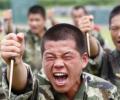
Close on the heels of over a dozen incursions since the face-off in Ladakh in April from across the Line of Actual Control, Chinese troops made a fresh attempt to violate the International Border at Chumar area in north-east of Leh on July 20, but were forced back by Indian troops.

Rights group vowed to continue the struggle for human rights in the Communist nation.

We can make a beginning by openly acknowledging the Russian help in 1971 victory when President Putin visits India on 6 December 2021. Showing gratitude to a friend is part of our DNA, notes Colonel Anil A Athale (retd).
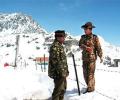
Ten days later, with the Indian Army in full control of the area where the incident took place, New Delhi has signalled a face-saver for Beijing.

The Defence Minister's reply came in response to a question on whether satellite images have revealed that China has constructed seven helipads in Doklam besides deploying tanks and missiles in the area.

'It is only when Beijing sees a country with an infirm political will such as India that it acts up as the PLA has done in eastern Ladakh.'
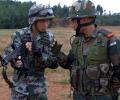
'The killings are a worrisome escalation of tensions, but little is known about the immediate causes or results of the fight in Galwan and it is not possible, at this point, to assign blame'
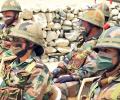
On the shopping list: Light tanks, anti-tank guided missiles, UAVs, assault rifles, fighter aircraft.

Chinese foreign policy will acquire a more ideological and less pragmatic character. It will be conducted with more nationalist overtones, predicts former foreign secretary Shyam Saran.

We're behaving like frogs in warm water. We swim around untroubled, cooled by our faith in Indian liberal democracy. We are blind to the bubbles popping around us, the bubbles warning of fundamental changes, says Mihir S Sharma.

China plans to divert about 200 billion cubic metres of water annually from the Brahmaputra at its highest point, namely the Great Bend, where it turns into India. China's Brahmaputra dam will severely impact India, warns former senior RA&W officer and China expert Jayadeva Ranade.

The fourth edition of the India-China joint training exercise Hand-in-Hand 2014 kick-started on Monday at the Aundh Military Cantonment in Pune.
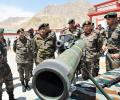
'China would want to take a tougher stance against India forming those strategic partnerships and prevent Quad from becoming a military alliance.'
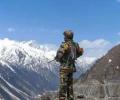
'China has forcibly occupied territory it had never occupied before, blocked Indian patrols' access to areas they had patrolled for decades and, most provocatively, killed 20 Indian soldiers.' 'Most countries would regard these as acts of war.' 'New Delhi has apparently taken off the table the option of evicting the PLA with force,' observes Ajai Shukla.

The inter-ministerial committee will coordinate investigation against Rajiv Gandhi Foundation, Rajiv Gandhi Charitable Trust and Indira Gandhi Memorial Trust.

'Gwadar has the potential to facilitate PLAN's operations in the Arabian Sea and Indian Ocean.' 'Reports of China setting up electronic eavesdropping posts at Gwadar to monitor US and Indian naval activity and shipping traffic through the Straits of Hormuz and the Arabian Sea lend credence to this,' says former RA&W officer Jayadeva Ranade.
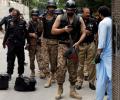
Chinese companies have large interests and investments in the Pakistan Stock Exchange.

Border incursion, the finalisation of the Border Defence Coordination Agreement (BDCA), a new mechanism suggested by China last year for improving security at the borders, pending the final settlement of the territorial dispute, top Antony's agenda for talks.

'One must remember that a dragon has a forked tongue,' warns Vivek Gumaste.
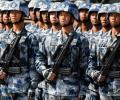
'They talk about their 2021 centenary goal, their 2035 goal, and their 2049 goal. They're accelerating. There's also been this unfortunately bashing of nationalism inside the People's Republic of China by the government'
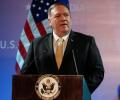
The United States, he said, 'desires a new age of ambition' in its relationship with India. Asserting that the US has never been more supportive of India's security, he said New Delhi too, is an important partner and a key pillar of President Trump's foreign policy.
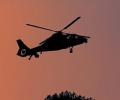
A suspicious low-altitude drone flying in the restricted airspace of the Chinese capital that sparked a major security alert and delayed a number of commercial flights, was shot down by the People's Liberation Army military helicopter, state-media reported one year after the incident.

Russia on Saturday staged a grand military parade in Moscow to commemorate the 70th anniversary of its victory over Nazi Germany in the presence of several world leaders, including President Pranab Mukherjee, even as Western powers boycotted the event due to a standoff over Ukraine.

China will increase its defence spending by "around seven per cent" this year, as it vowed to guard against "outside meddling" in its territorial disputes.
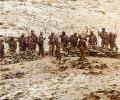
With the Indian Army having blocked the PLA several kilometres inside India, hundreds of soldiers from both sides remain in a tense face-off.

New Delhi must clearly demonstrate to Beijing that China will pay a price for its relentless strategic undermining of India, says Ajai Shukla.

'It is nobody's contention that uncomfortable questions regarding national security should not be raised. But that is a topic for another day and another time when the immediate threat has faded,' argues Vivek Gumaste.

Besides being the President, 62-year-old Xi is already General Secretary of the ruling Communist Party and Chairman of the Central Military Commission.
Hu Zhiyong, a research fellow at the Shanghai Academy of Social Science, claimed that India is provoking China because it wanted to prove to the United States that it could contain China while Prime Minister Narendra Modi was in the US.

Prime Minister Narendra Modi's visit to Arunachal Pradesh on Friday, February 20, irritated the Chinese government so much that it summoned the Indian ambassador to register its protest against Modi visiting a territory China claims as Southern Tibet.

For the first time, the Chinese military on Thursday acknowledged last year's incursion at the DepsangValley in Ladakh region and said such incidents occurred due to different perception about the Line of Actual Control.
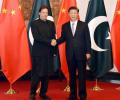
'The scheduling of Imran Khan's visit to Beijing and its focus on the J&K situation underscores that Beijing shares the Pakistani concern that tensions with India are only going to escalate further in the period ahead,' says Ambassador M K Bhadrakumar.

A visit by Indian journalists, sponsored by the Chinese government, on Monday turned into a propaganda exercise by the Chinese Army for delivering its message on the prolonged standoff between troops of the two countries in Doklam near Sikkim.

The PLA Air Force has conducted a combat air patrol in the South China Sea recently, which will become "a regular practice" in the future

Prime Minister Modi made a strategic blunder of Nehruvian proportions -- presuming no war can happen now, and the Chinese won't be a military threat and risk their economic interests, observes Shekhar Gupta.

'The fatal mistake for the USSR was the invasion of Afghanistan.' 'Quite possibly the fatal mistake for the Chinese empire is the assault on Ladakh,' observes Rajeev Srinivasan.

The aircraft carrier is China first domestically-built ship. Shandong is bigger than China's first aircraft carrier Liaoning and could house 36 fighter jets.

With tensions between China and Taiwan rapidly increasing, the tone of China's official media has also become progressively more strident, observes former senior RA&W officer and China expert Jayadeva Ranade.

This is the first time China-Pakistan began joint patrols in recent years though Chinese troops have been conducting patrols in the area since 2014.
